Herschel: 1960-1969
The 1960s was a time of change both for Herschel and South Africa. As Apartheid became even more severe and the violence under the Apartheid Regime escalated, Herschel Girls School was expanding and changing. These changes included the building of a new Science block, the appointment of a new headmistress and the introduction of a few other more minor developments.
At the beginning of the second term in 1960 a new headmistress was appointed. Mrs Mavis Kittow had been awarded a BA, HTD and had taught English at Rustenburg Girls’ High and at Cape Town Teachers’ Training College. Mrs Kittow had dreamed of becoming a singer, but tragic family events had forced her to get a job to support her family which highlights the sense of sacrifice and responsibility that characterised her personality. She was a very ambitious woman, as most women, of her time, would have stayed at home and looked after the children instead of having a job. Mrs Kittow introduced many innovations to Herschel of the 1960s that were to continue beyond her days as headmistress.
One of the first changes of 1964 included changing the Matric Dance from the fourth term to the third term. Matric dances would take place in the dining room which would be transformed for that evening by decorations that the matrics, themselves, had made. The dance started at eight o’clock and the girls danced till midnight with the a live band. Another change that occurred that decade was the alteration of the driveway in 1967 to a circular drive around the old oak tree. Two new Science laboratories were built for the Science Department that year. Science was becoming a popular subject to study at Herschel as the Science Department had to expand to accommodate all the girls taking Science.
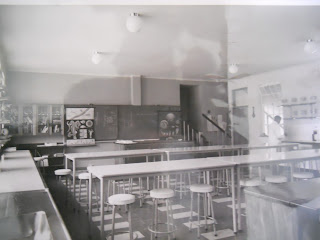 |
| A new Science laboratory in the Senior School built in 1967 |
In 1967, a new Science laboratory as well as a new hall was erected for the Preparatory School. During the 1960s, the Preparatory School had a “prep dog”, a Golden Retriever named “Chablis”, because she arrived in a wine box. Chablis accompanied Caroline and Clare Stern to school every day and became “part of the furniture” at the Preparatory School.
Even before the 1967 developments, the Herschel facilities had been expanding, as in 1964, the Kindergarten block at the Preparatory school was built. The Preparatory school was tight on space as the dining room doubled as an Art room after lunch. This was rectified by building an art room in the same year.
 |
| The Preparatory School in 1961 |
Art has always been a part of Herschel and the 1960s was no exception. Mrs Kittow was a very cultured woman who also appreciated music. Mrs Kittow thought that Science should be balanced with the Arts as too much emphasis was placed on Science alone. She then founded the Music and Drama clubs as well as the Choir, which still exists to this day. Debate evenings, which were regular activities on the school calendar, were often held at Wynberg Boys’, Wynberg Girls’, Bishops, St. George’s as well as at Herschel. The Inter-house Speaking Competition, in which groups of girls from different houses discussed and debated external topical issues in front of the school was started in 1965. This has continued through the years and is something Herschel girls still do today! Holiday reading was also started in this year. This programme, thoroughly supported by Mrs Kittow, expected girls to read a book from a recommended list, during the June/July holidays and write a test on their return to school on the first day of the third term. This tradition is still continued today, except girls are given a bit more time to prepare when it comes to the test date.
An artwork in the Rolt House Yearbook of 1967. The Artist is Chebyl Wale.
Mrs Kittow’s love of the English language often led her to correcting people’s language as well as the way in which they expressed themselves in letters they sent home. William Shakespeare’s Quarter century was celebrated in 1964 by Mrs Kittow and Professor Rosalie van der Gucht delivering speeches and lectures to commemorate his contribution to English. The annual house plays were all based on Shakespeare plays to celebrate the occasion and a bust of Shakespeare was given as a gift to the library by the Matrics of 1964.
Mrs Kittow retired at the end of the first term in 1970. She became Lady Warden of Tugwell Hall at UCT in 1971 and started a career as English Editor of the South African Biographical Dictionary. Under the Guidance and stewardship of Mrs Kittow, Herschel underwent a transformation. Many of these developments continue to be felt and appreciated.
Headmistress Mavis Kittow
Reference List
Saffery, Margaret, 1972. “The Stars Looked Down on Herschel”. Herschel Girls School.
1997. The Herschelian. 75th Birthday Edition.
1967. Rolt Year Book. Scrapbook.
Mrs Muller, M. 1962, no. 37, The Herschelian.
Mrs Muller, M. 1963, no. 38, The Herschelian


.png)


