Thursday, 18 October 2012

Herschel: 1960-1969

The 1960s was a time of change both for Herschel and South Africa. As Apartheid became even more severe and the violence under the Apartheid Regime escalated, Herschel Girls School was expanding and changing. These changes included the building of a new Science block, the appointment of a new headmistress and the introduction of a few other more minor developments.

At the beginning of the second term in 1960 a new headmistress was appointed. Mrs Mavis Kittow had been awarded a BA, HTD and had taught English at Rustenburg Girls’ High and at Cape Town Teachers’ Training College. Mrs Kittow had dreamed of becoming a singer, but tragic family events had forced her to get a job to support her family which highlights the sense of sacrifice and responsibility that characterised her personality. She was a very ambitious woman, as most women, of her time, would have stayed at home and looked after the children instead of having a job. Mrs Kittow introduced many innovations to Herschel of the 1960s that were to continue beyond her days as headmistress.

One of the first changes of 1964 included changing the Matric Dance from the fourth term to the third term. Matric dances would take place in the dining room which would be transformed for that evening by decorations that the matrics, themselves, had made. The dance started at eight o’clock and the girls danced till midnight with the a live band. Another change that occurred that decade was the alteration of the driveway in 1967 to a circular drive around the old oak tree. Two new Science laboratories were built for the Science Department that year. Science was becoming a popular subject to study at Herschel as the Science Department had to expand to accommodate all the girls taking Science.

A new Science laboratory in the Senior School built in 1967


In 1967, a new Science laboratory as well as a new hall was erected for the Preparatory School. During the 1960s, the Preparatory School had a “prep dog”, a Golden Retriever named “Chablis”, because she arrived in a wine box. Chablis accompanied Caroline and Clare Stern to school every day and became “part of the furniture” at the Preparatory School.
Even before the 1967 developments, the Herschel facilities had been expanding, as in 1964, the Kindergarten block at the Preparatory school was built. The Preparatory school was tight on space as the dining room doubled as an Art room after lunch. This was rectified by building an art room in the same year.  
  

The Preparatory School in 1961
                                
Art has always been a part of Herschel and the 1960s was no exception. Mrs Kittow was a very cultured woman who also appreciated music. Mrs Kittow thought that Science should be balanced with the Arts as too much emphasis was placed on Science alone. She then founded the Music and Drama clubs as well as the Choir, which still exists to this day. Debate evenings, which were regular activities on the school calendar, were often held at Wynberg Boys’, Wynberg Girls’, Bishops, St. George’s as well as at Herschel. The Inter-house Speaking Competition, in which groups of girls from different houses discussed and debated external topical issues in front of the school was started in 1965. This has continued through the years and is something Herschel girls still do today! Holiday reading was also started in this year. This programme, thoroughly supported by Mrs Kittow, expected girls to read a book from a recommended list, during the June/July holidays and write a test on their return to school on the first day of the third term. This tradition is still continued today, except girls are given a bit more time to prepare when it comes to the test date.

An artwork in the Rolt House Yearbook of 1967. The Artist is Chebyl Wale.


Mrs Kittow’s love of the English language often led her to correcting people’s language as well as the way in which they expressed themselves in letters they sent home. William Shakespeare’s Quarter century was celebrated in 1964 by Mrs Kittow and Professor Rosalie van der Gucht delivering speeches and lectures to commemorate his contribution to English. The annual house plays were all based on Shakespeare plays to celebrate the occasion and a bust of Shakespeare was given as a gift to the library by the Matrics of 1964.

Mrs Kittow retired at the end of the first term in 1970. She became Lady Warden of Tugwell Hall at UCT in 1971 and started a career as English Editor of the South African Biographical Dictionary. Under the Guidance and stewardship of Mrs Kittow, Herschel underwent a transformation. Many of these developments continue to be felt and appreciated.

                                                        Headmistress Mavis Kittow
                                                                  1960-1970


Reference List

Saffery, Margaret, 1972. “The Stars Looked Down on Herschel”. Herschel Girls School.
1997. The Herschelian. 75th Birthday Edition.
1967. Rolt Year Book. Scrapbook.
Mrs Muller, M. 1962, no. 37, The Herschelian.
Mrs Muller, M. 1963, no. 38, The Herschelian

Sport at Herschel
Since it’s inception in 1922, sport at Herschel has a dynamic and successful legacy. Throughout 90 years, not only has the variety of sport offered at Herschel evolved but the coaches and the prestigious facilities have too, enabling the girls to reach their full sporting potential.

The first headmistress, Miss Ralphe (1992-1933), encouraged sport than rather a purely academic education. She sent to girls to St.James to swim in Herschel’s very own bathing box. She took boarders hiking up mountains as well as encouraging a positive attitude towards competitive sport, win or loose. In 1939 the first swimming pool was built.

Mrs Robinson (1933-1944) initiated the sports fields, which were predominately for hockey. These were extended during Mrs Mclean’s reign (1947-1962). This undoubtedly gave Herschel’s sport a great opportunity to flourish. In 1955 the gravel was transformed into grass in order to accommodate this soon to be hockey field. Land for this was acquired from ‘The Hill’. ‘The Hill’ was purchased from the late Mr Jerrold Wilks. Hockey had developed to such an extent that overseas tours were taking place. The first tour was in 2001 to Australia and the most recent took place in Malaysia in 2007. In 2011 this field was transformed into an astroturf known as ‘The Field’. Much is still to be achieved on this field.

The first team of 2011 participating in a hockey tournament
                                                                                                                                                                                                                                                                                                                       
During Mrs Duff’s reign (1986-1997), the theatre was built and replaced three out of seven tennis courts. This lead to Herschel having to use the tennis facilities situated outside the school, which are still used today. At this time the summer sports offered were only tennis and swimming and the winter sports were only hockey and netball. Today Herschel offers nine summer sports, including aqua aerobics and waterpolo. In winter there are six sports to be played, including touch rugby and cross-country. At the end of Mrs duff’s reign, the Sports Centre was built and officially opened by Professor Tim Noakes. The Sports Centre accommodates netball; basketball; indoor hockey; squash and various other sports.

In 1990 Peter Morelli- after which the prestigious ‘Morelli Cup’ was named, introduced waterpolo. This was the start of a triumphant waterpolo career for Herschel as we are currently the highest ranked team in the Western Cape. The first team used to train at the Newslands pool until Mrs Van zyl (1997-2007) decided it would be best to build a new pool in 2006.
The waterpolo first team of 2011- preparing for a match against Wynberg Girls' High school

Various awards are given each year at the annual sports dinner, which is hosted in the Mary-Jagger Hall. It is not just the girls with the outstanding sporting achievements who are awarded; many awards are presented to those who show dedication, effort and spirit on the sporting field. Besides trophies for each individual sport, which are donated by previous pupils who excelled in a particular sport, there are also general trophies. The Leadership Trophy was donated by the sports captains of 2005 to any girl in a position of leadership who has shown an ability to inspire, motivate and engender team spirit. The Pickup Trophy was presented in 2003 by Cheryl and Jacqui Pickup for all rounder participation in sport. The Hannah Trophy is awarded to any girl in the school who has achieved honors in a school sport through dedication amounting to the most outstanding achievement of the year.      

True "H-Factor" spirit- Herschel girls supporting the first team hockey team play against Springfield Convent
Did apartheid affect sport at Herschel? Although under the Apartheid government, Herschel did accept people of colour to be educated and to partake in sport, as Herschel was a private institute. In an interview with Mrs Helen Botha, the director of sport at Herschel for over 30 years, she stated that she had only seen an impact of segregation in sport at provincial and national level after the Apartheid due to Sport Quotas.

Sport at Herschel has undoubtedly shown the development of women in society from the traditional role as housewife to independent individuals. Fortunately Herschel’s first headmistress, Miss Morley A Ralphe, encouraged ever girl to partake in a sporting activity. This included the European-influenced sports such as badminton and tennis, which abided to the lady-like 1920’s way of living. Cricket was offered as a school sport until 1962, which reiterates a strong European influence. The girls were not looked down upon by boys’ schools but rather enjoyed playing friendly sports with one another.

On 5 December 1922 the first tennis court was built. Later the sport grew and more tennis courts were needed which led to more courts being built on 2 February 1924. On this day, Herschel played a friendly game of cricket with Western Province Preparatory Boys’ School and sadly lost.
Herschel's tennis courts in 1988
                                                                                                                                                                                       Herschel sport has not only produced many well-known sport stars such as Paula Dollam, who was the U18 hockey player of the year in 2008, and several other Springbok representatives, it has also taught the girls many lessons. These include teamwork, determination and friendship. Representing Herschel on the sports field is an honor- past, present and still to come.

Authored by Georgina Buchanan and Sophie Mitchell

Wednesday, 17 October 2012

Community Service (1982-2012)

Over the past three decades, Herschel’s community service programmes have grown tremendously. For most of the 1980’s, all community service was handled by a small group of girls running the Social Responsibility Club and today, community service plays a role in the lives of every single student at Herschel.
The Grade 9 girls of 2009 transforming two bedrooms at The Place of Hope, a home for abandoned and abused mothers and children.
1982-1992
Community service was in the hands of the Social Responsibility Club. They would choose a few organisations such as the African Scholars Fund and Beauty without Cruelty, whom the girls would raise funds for throughout the year.
Annual events included ‘Operation Easter Egg’, an Easter egg collection for various orphanages, the yearly Christmas Party for the children of the ground staff at Herschel and ‘One-to-One day’, a fun-filled day for handicapped children of the Western Cape. The Social Responsibility Club was also extremely involved in serving Lelieblom House, a children’s home and Haven Night Shelter. The girls also volunteered to assist at events like the Cape Argus Cycle Tour and the Community Chest Carnival.
The Interact Club was founded in 1987. It was a development from the Social Responsibility Club.  Interact had a link with Rotary International and thus, aroused many more opportunities to interact with other community service organisations in the area. In the year 1990, the Interact Conference was hosted by Herschel. Over 300 ‘interactors’ from various organisations attended the conference. The establishment of The Interact Club saw tremendous growth in the number of volunteers for community service.
Outreach Club hosts a party for learners from St Louis Primary, Kewtown Priamary and Rosmead Primary.
The Environmental Club was established in 1991. At the time, The Bird Club and The Mountain Club existed too. These clubs focused on the conservation of birds and the ecosystems inhabiting our mountains. In 1992, these clubs decided to combine and were named the Outdoor Club. This club was involved in activities such as clearing alien vegetation from the University of the Western Cape and raising funds for various wildlife organisations. They concentrated on the conservation of the Western Cape.
1993-2002
Community service at Herschel was now thriving under the control of the Interact Club. There was a vast increase in the amount of projects that the girls took on. Projects that were brought forward from the previous decade included the annual Christmas Party, ‘One-to-One day’ and the Easter egg collection. The girls now had weekly interactions with handicapped and underprivileged children, as well as the elderly. Herschel was a regular benefactor of St Luke’s Hospice over this decade.
In the year 1993, recycling programmes were introduced to Herschel by the Outdoor Club. In 1996, the Environmental Awareness Club was established. This club was a development from the Outdoor Club.
The first Enrichment programme was established in the year 1999 and only catered for the Grade 8 learners at Herschel. The theme of the programme was ‘Our Mother City’, which explored Cape Town and its people.
 The year 1999 also brought the Establishment of the Outreach Club. The Outreach Club branched out into various domains, including outreach computers, drama and catering. The girls also tutored the Matric class of Thandokhulu in Mathematics, Afrikaans and Biology.
The first Outreach Camp was in the year 2000. This camp concentrated on skill training and workshops for the Herschel Girls involved, as well as Grade 12's from Langa, Fezeka and Thandokhulu.
Herschel Girls making sleeping bags for the homeless during Enrichment week 2011.


2003-2012
At the beginning of this time period, Herschel’s community service initiatives show significant changes in the way this portfolio was organised. Many girls from the preparatory up until the high school have always supported the community whole-heartedly.
SMILE (St Mary’s Interactive Learning Experience) was introduced in 2003. It is organised and run by the senior head of community service, Mrs G van Blerk. It is a programme which oversees Herschel girls teaching English to primary school learners from various underprivileged schools. By 2010, Herschel’s Outreach portfolio at the senior school expanded to Outreach Art, Music and History. JUMP HI was an initiative started in 2006 to improve the Maths skills of children from underprivileged primary schools by having senior Herschel girls tutor them.
The enrichment programme has now been lengthened to a full week of community service projects and workshops to broaden the thinking of Herschel girls towards their communities and environment. By 2004, the Enrichment Week catered for grade eight to ten at the senior school. In 2007, the grade eleven girls were also included.
Meanwhile, at the junior school, learners are very instrumental in donations towards worthy causes. The grade sevens held their annual Grade Seven Fair and donated all of their profits to a worthy cause chosen by the Interact board.
The increased involvement in community service at Herschel has prompted leaders into initiating their own clubs such as Red Nose Chicken Club (a care-clowning club which visits Maitland Cottage weekly, and Golden Oldies Club (visiting the elderly in the community). Community service over the years has become a part of everyday life for the girls at Herschel and has equipped Herschelians with the tools needed to make a difference in their communities.


1970-1978: Dr Barbara Silberbauer and the Golden Jubilee Celebration


1972 was a particularly eventful year for Herschel as not only was it the 50th anniversary, celebrated with a Golden Jubilee Pageant, but it was also the first year as headmistress for Dr Silberbauer, along with several other achievements and improvements throughout Herschel.

In 1972, Mrs Helen Brownell retired as substitute headmistress, giving way to Dr Silberbauer, a Natal university graduate and previous member of staff at Herschel. Dr Silberbauer lectured at Cedara Agricultural College while completing her Master’s degree, before becoming a junior lecturer and demonstrator at the University of Cape Town’s zoology department. She then joined Herschel as a biology teacher in 1958, and was warmly invited by some of the council members to apply for Head of Herschel in 1970.  


Photograph of Dr Barbara Silberbauer
 (Source: 1972 The Herschelian Magazine)


Various changes took place during Dr Silberbauer’s time as headmistress such as constructions of new facilities and buildings as well as alterations in the girls’ curriculum.

In March 1972, Dr Silberbauer initiated the construction of "The Hill”, a nursery school that would act as a feeder school to Western Province Boys' and Herschel Preparatory School.  Starting off with 84 children who were supervised and cared for by Bridget Sholto, the children enjoyed not only their schooling, but also fun times with climbing frames, Trestel Planks and wooden ‘wendy houses’.

Another new initiation by Dr Silberbauer were the six new classrooms above the assembly hall at the junior school as well as an intricate walkway linking all classes, providing shelter from the harsh weather in winter.  The staffroom was moved from the current chapel to the old kindergarten rooms where it still resides today and a tunnel was also built underneath the dining room providing a link to various classrooms.

At the senior school, the boarding house renovations were underway. Separate cubicles for each senior student were built, which in return demolished the sleeping balconies. The "maid’s quarters" were refurbished as well as all the bathrooms, sitting room and dining room, and in 1974 the Edna Withers Kitchen, a fully furbished Home Economics classroom, was completed.

Many changes also took place concerning the girls’ subjects and what they were involved in at school. In 1974, there was an important change in the educational policy. Girls had to make subject choices in Standard 7 which would define and limit their future options. They also would have to choose Higher or Standard Grade, but this could be changed up to the middle of their matriculation year. The girls’ subject combination had to be carefully considered, as this too would determine whether they received Matriculation Exemption or a School-Leaving Certificate.

The school had thriving arts and culture. The Drama students were doing so well that Drama became a Matriculation subject. The Art department was flourishing under Mary Muller, Heather Montgomery and Caroline D’Unienville’s management. Pottery was started as a craft, plays were produced, and musical evenings and the first Art exhibition were held. Domestic Science became Home Economics in a modernised classroom.

Dr Silberbauer's love for the arts fueled the construction of a new cultural block, in 1976, which would provide specialized areas for each art form. New music rooms were built on the ground floor, equipped with all necessary items needed and above, art rooms were established.  A new drama room was built acknowledging the new subject choices provided by the school.


The new arts block, completed in 1977
(Source: The Herschelian)


The clubs: the Sociological Club, the Historical Society, the Music Club, the Music, Art and Drama Society, MIX, the Debating Society, the Gym and the Mountain clubs, each in their own way, offered extra-mural activities of interest to all. Dr Silberbauer’s impression was that the interest shown in those societies by girls gives creative drive and impetus to studies as well as sport.

1972 was also a particularly busy year for the Herschel choir. They took part in two Sunday services at St Saviour’s which were directly recorded over the SABC, as well as singing at weddings of many old girls, the Ascension Day Service and at Music and Drama Club meetings.

They also appeared regularly throughout the school’s 50th year anniversary which was celebrated by a ‘Son et Lumiere’ production in 1972, written and produced by one of Herschel’s early pupils, Marian Robertson.

To mark this Golden Jubilee, Herschel presented a pageant on the evenings of the 17th, 18th and 19th of April. It was a reflection of the history of Herschel, performed by present pupils and staff as well as contributions from old Herschelians.


Old Herschelians at the Golden Jubilee Pageant
(Source: 1972 The Herschelian Magazine)


Herschel’s past was brought back to life with a magnificent façade of the main school building while the girls performed various activities such as sewing and knitting while accompanied by a guitarist who wonderfully executed the pageant’s theme song, ‘The Stars Looked Down’. In the second half of the program, various Old Herschelians supplied a narration with a personal appearance or a voice recording before several excerpts from previous plays were once again enacted. The choir also sang, as was done on all significant occasions.


The narration group at the Pageant 
(Source: The Herschelian)


The Golden Jubilee pageant was a superb event and will be remembered by all of those who took part in the celebration for years to come.

Monday, 15 October 2012

1980-1989


The 1980s was a decade of innovation and modernisation at Herschel and when inducted as headmistress in 1986, Mrs Pamela Duff (at that time Ms MacDonald) ensured that this was continued throughout her time at Herschel. At the time of her arrival at Herschel, Mrs Duff asked pupils to list what they believed to be the main priorities of the school and what would serve them well in the coming years. Most frequently mentioned by the girls included the introduction of computers because, although typing was offered as a subject for the matrics, there were no computers at the school, also suggested were computer teachers and a Guidance and Careers counsellor. However, at the top of everybody’s lists was a new theatre.
A high side-view of Herschel in the 1980's
Speech and Drama were offered as a matric subject at Herschel in the 1980s, but there was no theatre in which to perform or rehearse. The only option was the Mary Jagger Hall. The Mary Jagger Hall was used for the majority of events, occasions and large group gatherings, including assemblies, where pupils sat on the floor, and Physical Education. Essentially, it was used as a multi-purpose venue, serving as a Gym Hall, Lecture Room and Theatre for pupils, staff and parents at Herschel. Using this venue as a theatre for school productions and Speech and Drama lessons was not ideal because the Mary Jagger had ropes hanging from the ceiling as well as parallel bars on the walls for exercising. There were no stage wings, backstage or dressing room. There was a strong sense that this hall simply was not sufficient and so, in the first term of 1988, the building of the theatre commenced. This continued throughout the fourth term of that same year. The theatre was officially opened by the Mayor Ald. Peter Muller on Wednesday, October 5th. One particularly interesting fact about the theatre is that there are only 299 fixed seats. Had they built 300 seats or more, they would have to have installed a fire curtain in front of the stage; something that they simply could not afford. In order to solve the issue of the lack of seating, sliding doors were installed at the back of the theatre so that there could be more space for chairs to be put in the foyer area. The first play held in the theatre was the Wizard of Oz, with the production running from October 19th to October 22nd. Also in the fourth term, the first speech day was held in the theatre at which Mr Raymond Ackerman owner of Pick ‘n Pay was the guest speaker. He was chosen as guest speaker because he was, in fact, an old Herschellian as he had attended Herschel in his Nursery School years during a time in Herschel’s history in which boys could attend Herschel at this level.

The theatre during the construction in 1988
The theatre was not the only building development seen in the 1980s. In the first term of 1989 a tuckshop, two classrooms and the Molteno lecture theatre were also built. Plans also were created for a new Pre-Preparatory building, which was completed in the fourth term of the same year. In addition to the classroom’s being built, the Headmistress’ house was built. During Miss Geldard’s time as headmistress she lived, during the week, in what is now known as the admin block, under the boarding house. The Head’s office used to be where the reception is now in 2012, the lounge/dining room is where the currents head’s office is situated, and the head’s bedroom was where the headmaster’s PA’s office is presently. When Mrs Duff came to Herschel (at that time her name was Miss Macdonald) she refused to live under the boarding house and therefore the school agreed to build what is now known as the Head’s House in what was known as the ‘Cabbage Patch’ and was next to the old tennis court. Her secretary moved below the boarding house.  Her and her new husband Mr Duff moved into the house in July 1986 and had planted and bought various plants to surround their new house.
Mrs Botha (a teacher who still currently works at Herschel and who worked there during the 1980’s) thought that the biggest change from the 80’s was that of the campus and that the number of students has doubled. She commented that Herschel in the 1980’s was a happy place to be, not very competitive and was not run like a business and that there are now many more sports and subjects available to the students. Mrs Adley (who was also a teacher then) said that the school is still very similar to what it is today but also comented on the growth of the school, in number and buildings.
The 1980’s were a time of growth and development for Herschel as a school and can be said to be the foundation of the school life today.

Saturday, 13 October 2012

Staff


I have compiled a report giving an account of the staff of Herschel Girls High School from 1922 - the start of the school up until the current year, 2012. Unfortunately, for many of the years there were few staff members and not much thought was given to the staff. The names, numbers and subjects they taught were not recorded well until 1982 and consequently, historically speaking, much information has been lost.

1922
Miss Morley A. Ralph (1922 – 1933)

In 1922 when the school first opened, there were only four members of staff.
Miss Ralph, the head of the school; Miss van Heyst – English; Miss Seabridge – Music; and the trained nurse and house mistress, Miss Statford.

1932
Miss Morley A. Ralph (1922 – 1933)

Miss Harriet Robinson (1933 – 1944) was the new head in this decade as Miss Ralph left in 1933.
In this year, one person had left and no more staff had joined. The school now also accepted staff members that were married.

1942
Miss Harriet Robinson (1933 – 1944)

Miss Barbara Elcome (1945 – 1947), successor to Miss Robinson was only head for a short two years. Miss Elcome married in 1947 on the 31st July, in England. After her Miss Caroline McLean (1947 – 1962) served as head. That year, two more women joined the staff. On the 5th of June that year, there was a staff play reading by the name of “Tons of Money”. £23 was raised for war funds.

1952
Miss Caroline McLean (1947 – 1962)

Miss McLean was the head for the whole of this decade and under her leadership, just in 1952, there came 13 staff members. Not a single person left that year either.

1962
Mrs Mavis Kittow (1962 – 1970)

Another 13 staff joined in 1962, but 5 left. Dr Barbara Silberbauer (1970 – 1978) became the new head in 1970 and also served for eight years like Mrs Kittow. Dr Silberbauer is to this day the only head with a doctorate.

1972
Dr Barbara Silberbauer (1970 – 1978)
In 1972 Miss Montgomery who had taught at Herschel for over thirty years and Miss Winifred Mulliner who had taught since 1949, tragically passed away. There were no changes to staff. Miss Pamela Geldard (1979 – 1985) was also head in this decade.

1982
Miss Pamela Geldard (1979 – 1985)
Between 1972 and 1982 a major change had occurred in staff numbers, positions, and structures. There were now thirty eight Senior School teaching staff, eight administrative staff, thirteen kitchen staff, seven ground staff and eleven part time staff. A position as vice principal had opened and Mrs S. Gillham had filled this position. Another Pamela, Mrs Pamela Duff (1986 – 1997) became head after Miss Pamela Geldard in this decade.

1992
Mrs Pamela Duff (1986 – 1997)
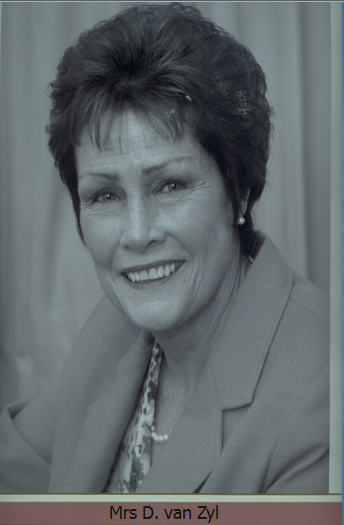
Not many things changed in the next decade. There were thirty two Senior School teaching staff, nine administrative staff, fourteen Music staff, four boarding staff and seven part time staff. The numbers for ground and kitchen staff stayed the same and there were now sixteen people on the Council. Senior teachers were P.L. Allen and Mrs C. M. Brathwaite and deputy head, Mrs M. Robinson. Mrs Diana van Zyl (1997 – 2007) would be the next headmistress of Herschel.

2002
Diana van Zyl (1997 – 2007)
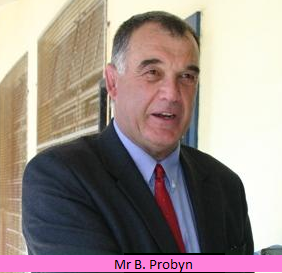
This decade saw through further changes. Ground staff branched off into estate (six) and maintenance (two) staff. Kitchen staff remained as thirteen. Administrative staff increased to an unbelievable twenty people and part time staff increased to ten. Senior teachers included Ms D.M. Baws, Mr A.P. Scott, Mrs M. van Schalkwyk and the chaplain, Revd. J. Tyres. The Council consisted of fourteen people. Deputy, Mrs L.C. Clarke. Mr Bruce Probyn (2008 – 2012) would be the next headmaster for five years.

2012
Mr Bruce Probyn (2008 – 2012)

A major change occurred for the first time ever in Herschel history; the first male principal ever – Mr Probyn. Mrs L.C. Clarke is still the deputy head and senior teachers Ms D.M. Baws, Mr A.P. Scott, Mrs M. van Schalkwyk remained as well, but with the addition of Mrs S. Grové and the Revd. B. Commin. The Council remained constant at fourteen. There are now fifty two Senior School teaching staff; six part time; eleven kitchen staff; eleven estate staff; six maintenance staff and twenty two administrative staff.

It has been ninety years of hardworking, dedicated staff and ten different principals. From four unmarried female educators, to over one hundred and twenty two staff members, male and female; married and single, in the Senior School alone. In 2013, we will welcome Mr Stuart West as the new headmaster of Herschel Girls High School.
References:
Authored by Shinoa Foflonker